Antonio Donghi
Antonio Donghi
(Rome, 1897-1963)
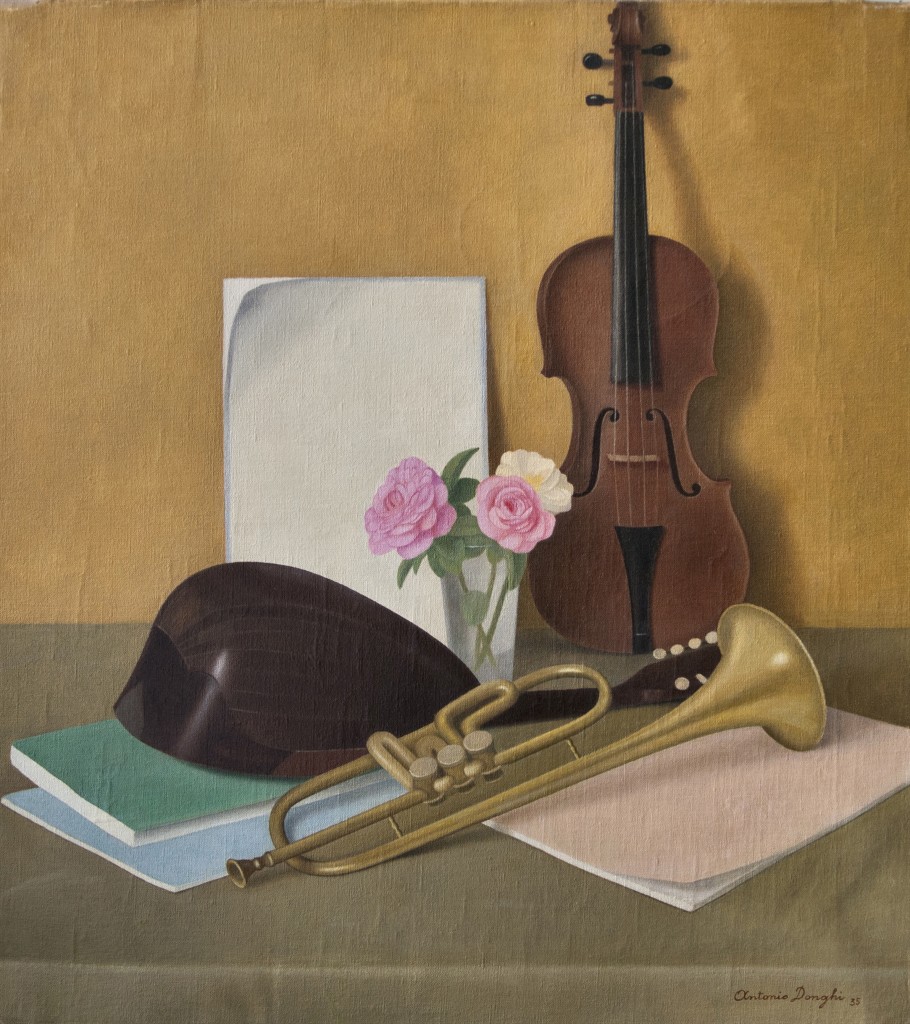
Still life with musical instruments
1935
oil painting on canvas; 64x56cm
Inscriptions: bottom right "Antonio Donghi 35"
Since the mid-twenties Donghi has participated in numerous international exhibitions, not only in Europe but also in the United States. In 1926 he presented ten works on the Exhibition of Modern Italian Art, organized by the Ministry of Education and hosted in various American cities, while the following year he held a solo show in New York. Towards the end of the twenties he often exhibited abroad with the Italian Novecento team, attending the significant international release in Buenos Aires, in 1931.
An important moment for his success in American collecting is the participation in the XXVI edition of the Pittsburgh Carnegie Award, in the autumn of 1927. These are the years in which the exhibition is curated by homer Saint-Gaudens while promoter of Italian art in Pittsburgh is the Venetian Ilario Neri. The jury, where Felice Casorati and Maurice Denis sit, assigns Donghi the First Honorable Mention for the opera Carnevale, which shortly after enters, along with other works, in an American collection.
During the thirties, there were numerous acquisitions of Donghi's works also by Italian museums and in 1935 the artist presented an important nucleus of works at the Rome Quadriennale. He received many awards, up to the first monographic essay dedicated to him, which came out in 1942, in the Italian Modern Art series directed by Giovanni Scheiwiller (Sinisgalli 1942). The relationship with the American world continued into the second post-war period and was witnessed by the invitation, in 1949, to the famous Twentieth-Century Italian Art exhibition, curated by James Thrall Soby and Alfred h. Barr for the MoMA in New York. In the production of Donghi, the figures in interior and exterior and the most articulated compositions, there are numerous still lifes, especially of flowers or fruit, always rendered with extreme simplification of shapes and volumes, with vibrant contrasting colors and cut from a unreal light, aimed at creating a suspended atmosphere, a new time and a new space, as Massimo Bontempelli wrote in the first issue of the magazine "900": "The most urgent task of the twentieth century will be the reconstruction of time and space" ( Bontempelli 1926). Compared to still lifes with flowers or fruit, this painting of ours presents a more rare subject in the production of Donghiana and a more complex articulation of the elements. It is a genre dear to the Italian tradition starting from the seventeenth-century production of Evaristo Baschenis from Bergamo, taken up by numerous artists during the 1920s. In the "return to order" Italian climate, references to music are frequent, as in still life with instruments made by Piero Marussig and Achille Funi. Compared to the German context, Still Life with Musical Instruments approaches the rehearsals of Alexander Kanoldt, one of the exponents of the classical and Munich wing of magical realism.
In the monograph of Leonardo Sinisgalli (Sinisgalli 1942) the work was attributed to the collection of Baroness Anita Blanc, while the identification with the work exhibited at the 1936 Biennale is confirmed by a photo kept in the archives of the Venetian institution. In other still lifes of a similar subject, Donghi re-elaborates the same elements, including the score, the violin and a vase of flowers, always maintaining a high concentration on the synthetic rendering of the elements and on the alienating value of the composition. One of these, dated 1940, went on auction at Sotheby's in 2011 and came from the famous collection of New York gallery owner Alexander Jolas, further confirmation of how Donghi can be considered not only a trait d'union with Northern European realism, but even with the American world.
Bibliography: XX Esposizione 1936, n. 26; Sinisgalli 1942, tav. XXV; Antonio Donghi 1983, Rome, Galleria dell'Oca, n. 16 (dated 1936); Antonio Donghi 1985, p. 136; Arc Bean, Rivosecchi 1990 p. 205, n. 103.
Elisabetta Barisoni
SOLD
Author: Antonio Donghi
Dimensions: cm. 64 x 56
Year: 1935