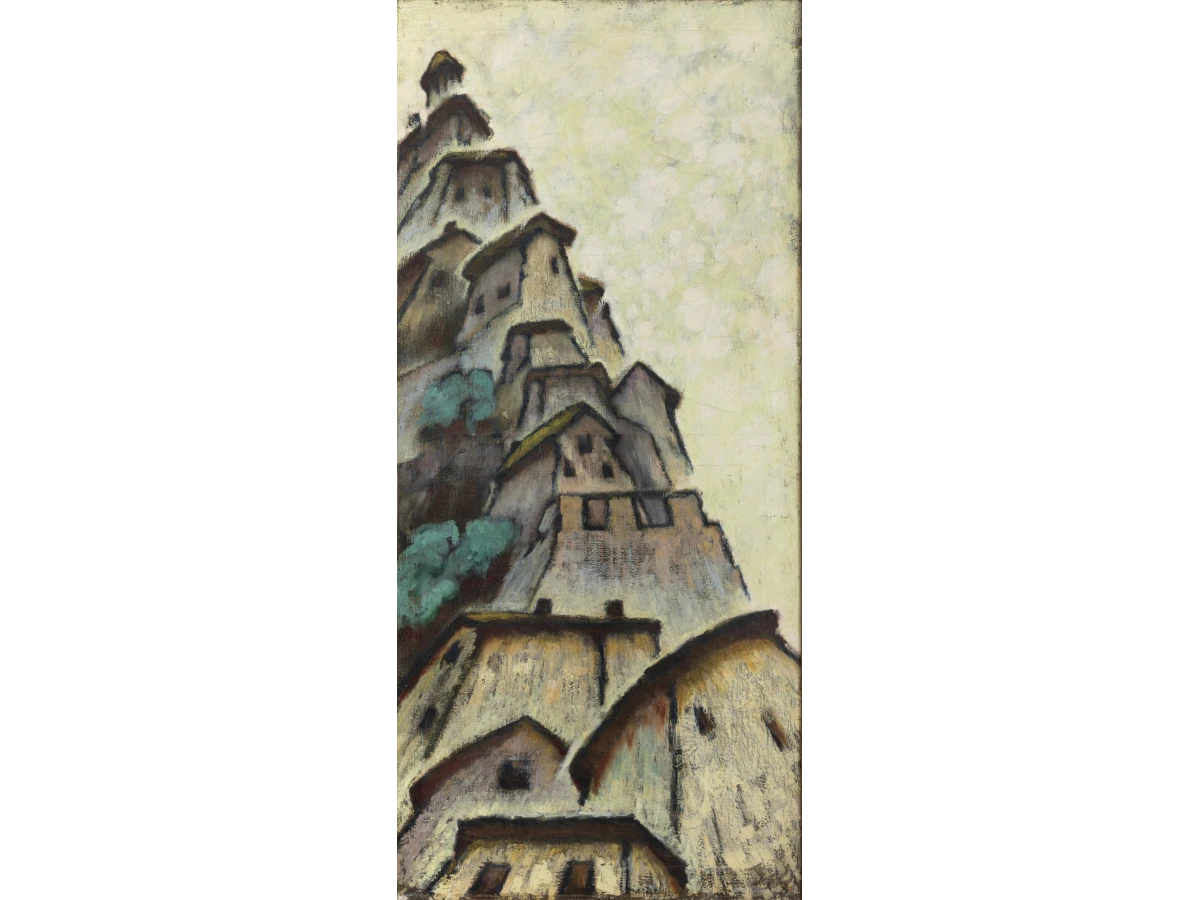
Ascension
After her academic training in Königsberg, the young Edita Walterowna moved to Paris, coinciding with one of the most fervent periods of avant-garde exploration and exploration. She then settled in Rouen, where a group of artists led by Robert Pinchon and Pierre Dumont, closely connected to the developments of Fauvism and united under the name "École de Rouen," was active.
Consistent with the research she had begun in France, upon arriving in Rome in 1912, the artist became close to the group of young artists who, the following year, came together to organize the Roman Secession, which initially also included the Futurist group led by Giacomo Balla. Founded in opposition to the exhibition organization of the Society of Amateurs and Cultivators of Fine Arts, the association brought together, among others, Felice Carena, Armando Spadini, and Ferruccio Ferrazzi, whom Broglio had met through their frequent visits to the salon of Olga Resnevic Signorelli, a Russian exile and wife of the collector and patron Angelo Signorelli. This group of artists often stayed during the summer months in the small rural village of Anticoli Corrado, in the Aniene River valley, which at the time was connected to the capital by a railway line and therefore easily accessible. The village, already a favorite destination since the mid-19th century for numerous painters drawn there both by the renowned beauty of its inhabitants, who worked as models in the capital, and by the enduring charm of nature and customs, continued to attract artists such as Arturo Martini, Angelo Zanelli, Attilio Selva, Ivan Meštrović, Henry Moore, Eric Gill, Edward Okuń, as well as writers such as Luigi Pirandello and D.H. Lawrence.
Edita's participation in the first exhibitions of the Roman Secession was consequently accompanied by her frequent visits to Anticoli Corrado, and it was likely the view from one of the studios near the so-called "gliva murata," from which one could see the profile of the spontaneous architecture grafted onto one another on the opposite side of the hill, that inspired the title of the composition, Ascension. The work's dating to 1913 allows us to anticipate by a few years the artist's visits to the Lazio town, commonly attributed in the literature to the two-year period 1915-1917, coinciding with the First World War, when Broglio settled there almost permanently.
In Anticoli, Edita found the transposition of that "influence of the darting iridescence of the sun's rays, transformed into sparkling light that strikes things," to which she referred when recalling the "emotional and phenomenal" beginning that coincided with her artistic affirmation.
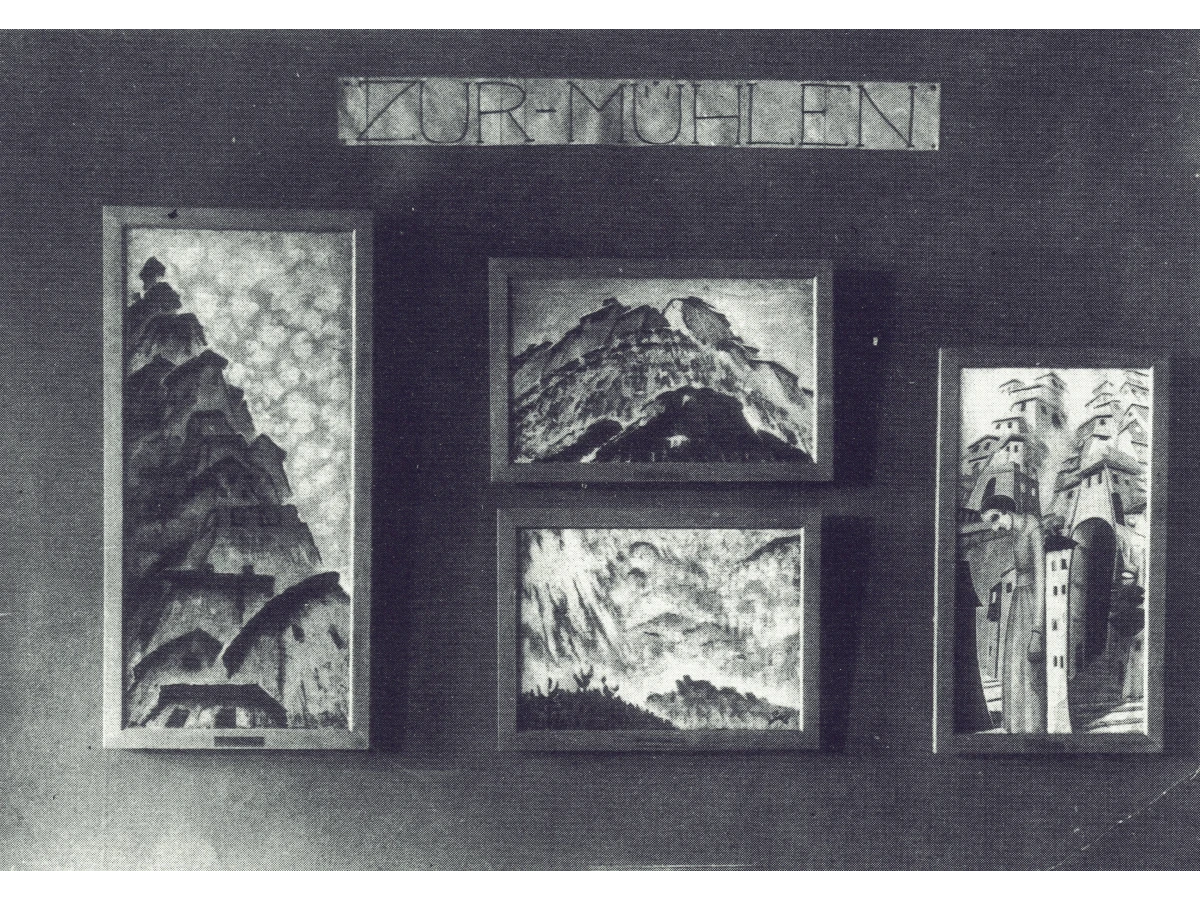
Ascension is part of a collection of works related to the village in Lazio, all executed in the two-year period 1912-1913, some of which were published in the magazine "Valori plastici," along with a series of drawings that equally reveal the evocative power of the place and the rural life that was led there. The series, in which the village in Lazio is easily recognizable, includes the paintings "Ascension in Red (Uphill Landscape)" and "The Origin of the Dome," as well as various works titled "Incandescent Country" and "Incandescent Mountain," "Casetta Anticoli," and "Forze di gravitazione." Along with "Ascension in Red," "The Origin of the Dome," and "Incandescent Mountain," the work was also exhibited at the exhibition "Das Junge Italien," held in Hanover in 1921, demonstrating the importance of the work carried out in the previous decade, including his membership in the "Valori plastici" group and the more disciplined orientation of pictorial research that would characterize the artist's work in the 1920s. The following year, some of Broglio's anti-Colon works, including Ascension, were exhibited again at the Florentine Primaverile, presented in the catalog by Alberto Savinio, who noted that "the works of that period appear as the fruits of an almost somnambulistic intoxication." The exhibition also drew negative criticism from Corrado Pavolini, who compared Broglio's work to the research of Leonardo Dudreville and to "that formal avant-garde of external strangeness [...] beneath which
there is no essential modernity." The comparison with Dudreville was likely prompted by the affinity with the 1917 work Aspiration (Autobiografico), which featured a similar representation of the city along a vertical axis marked by "ascending" luminous tones.
Broglio's visionary and "flamboyant" imagery that characterized the painting of the 1910s, dominated by the research into light and formal exaggerations, undoubtedly reflected the Fauvist suggestions already breathed in during the French years, but also that idea of a "prismatic" vision that Emilio Cecchi had already underlined on the occasion of the Second Exhibition of the Roman Secession, where Broglio had exhibited a Country (once again Anticoli), relevant
Artist: Edita Broglio
Year: 1913
Dimensions: 122 x 56