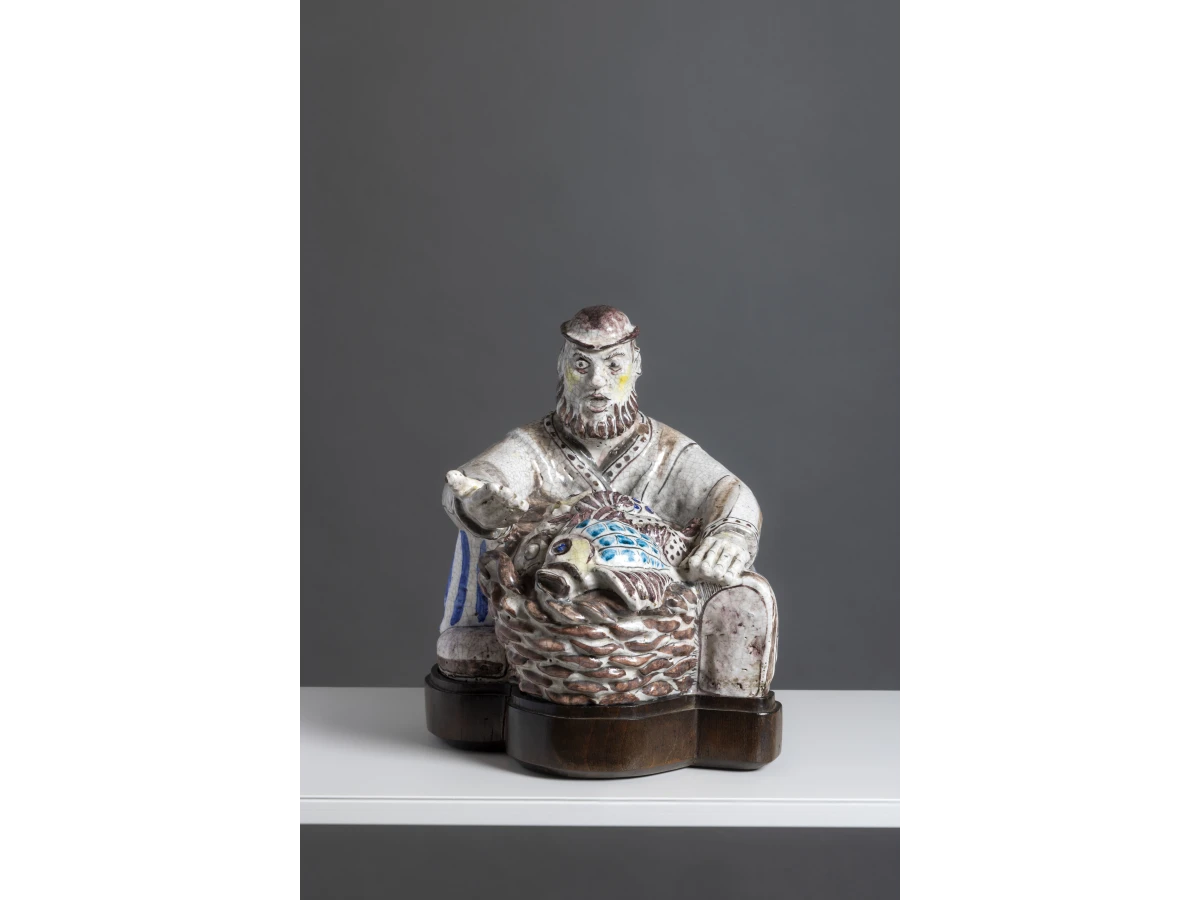
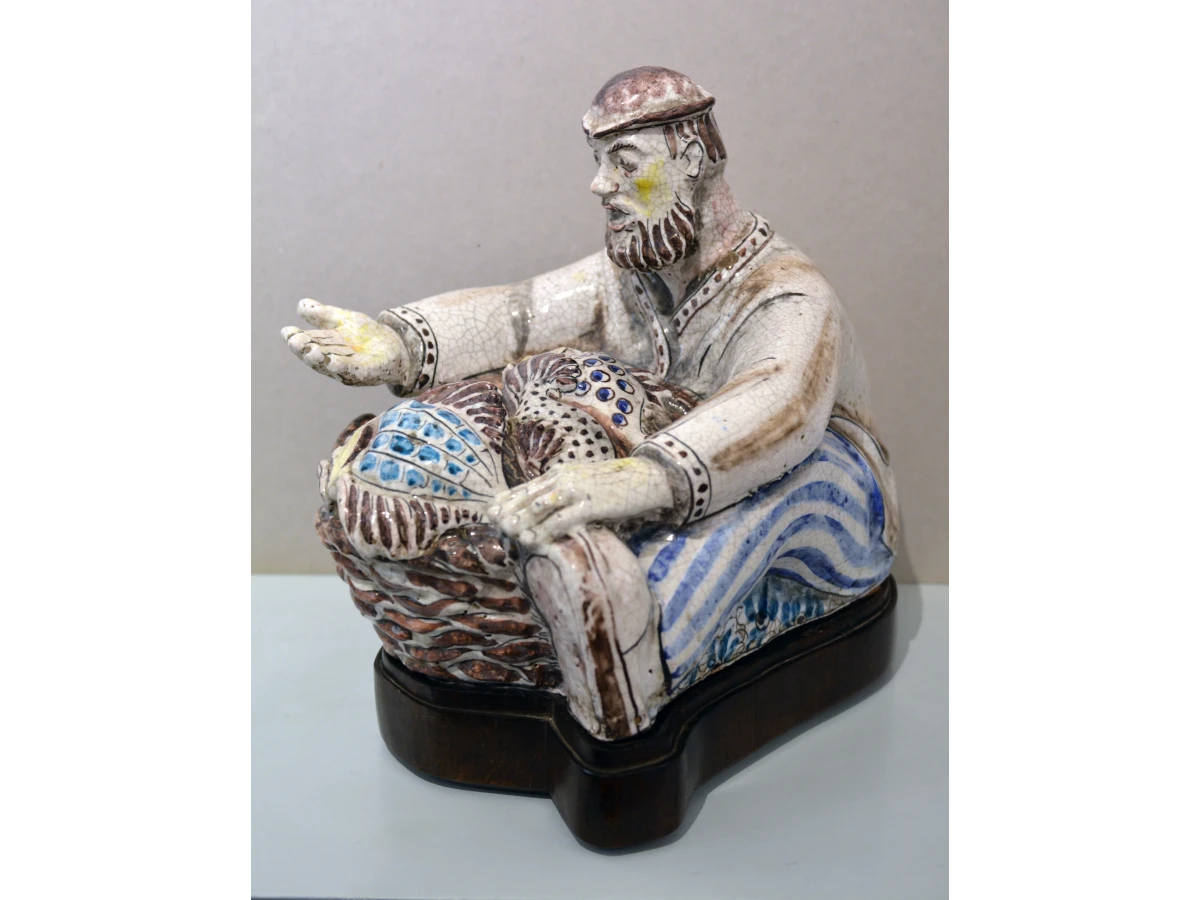
Fishmonger
Guido Balsamo Stella, at the first Monza exhibition in 1923 (and we must always refer to that exhibition as the founding act of our modern decorative art), was among the very few "signatures" I've already mentioned in this same magazine, whom we could place in line with the excellent foreign production.
I remember him, poor Balsamo, tall, massive, limping, seemingly filling the small rooms he was noisily tidying up in that tiny section of Tuscany, or rather, Florence, or better yet, of a few Florentine artists and industrialists and of the Santa Croce school, whose direction had just been modernized, with Libero Andreotti being called in to teach plastic art, and Balsamo Stella, precisely, the art of the book. His booming voice was always the loudest and most insistent on the entire first floor of the Royal Villa, and you could hear him ordering a nail to be hammered into the wall, for a small painting, with the same impetus as someone ordering the firing of a full volley of cannon. He never sat still or silent for a moment; and his fervor, his constant desire to converse, to argue, even to quarrel with someone, his broad gesticulations amplified by the swings of a knotted stick, were even more striking in contrast with the constant, calm, and gentlemanly composure of his inseparable wife Anna Akerdahl, who had always been his most devoted, intelligent, and listened to collaborator.
Balsamo Stella, a painter and etcher, awarded a prize in Munich and highly regarded in Germany and Sweden, where he had traveled in 1914, turned to decorative art after witnessing the birth of the splendid Orrefors glassware, which immediately became famous throughout the world, in a glass plate and ink bottle factory. This example inspired him to revive the art of engraved crystal in our country; his friendship with Edward Hald, who, along with Simon Gate, gave the first impetus to the Swedish glassmaking industry, allowed him to study the technique in depth. Ever more enthusiastic, he traveled to Bohemia to visit the most celebrated factories there. There he met and struck up a rapport with the engraver Franz Pelzel, bringing him with him to Florence and immediately setting to work on the beautiful pieces to be exhibited in Monza. These were the beginning of the repertoire of vases, vessels, bowls, plates, and mirrors that made the harmonious duo of the creative artist and the highly skilled executor known and esteemed, and not only in Italy. The series expanded when Balsamo moved to S.A.L.I.R. in Murano, for which he also designed the blown glass statuettes and groups for the 1930 Triennale and the so-called chemical glass pieces, inspired by the rigorous forms of test tubes, laboratory funnels, retorts, and stills. And this was not a personal whim, but a product of the climate of the time. One might recall, if nothing else, the impressive German section at the same exhibition, all authentic chemical glass, electrical appliances, kitchen utensils, and the like.
After that, Balsamo returned to etching and painting only in his spare time; his world was decorative art: he designed furniture, modeled ceramics, and was always drawn to other materials, other techniques, both old and new. And more than his own work, he gradually became more passionate about teaching and the work of his students. From Florence, he served as director of the Ortisei woodworking school and, simultaneously, inspector of all the schools in Val Gardena, then acting director of the Selvatico school in Padua, and was then called upon to reorganize and direct the Monza high school.
C.A. FELICE
Bibliography/Exhibitions:
Stile no. 10 October 1941 pp. 40/41 f. 7; Lands of Europe Piacenza 1996 edited by G.C. Cammi and D. Simonazzi, Fatti d’Arte Association (period photo)
Artist: Guido Balsamo Stella
Year: 1932
Dimensions: 35,5 x 37 x 29 cm