Pan and Syringe
After studying sculpture at the Vienna Academy, Lajos Mack moved to the Zsolnay manufactory in Pècs in 1899, where he remained until 1922. His collaboration with the company began with the design of a collection for the 1900 World Fair in Paris. The manufactory won first prize at that exhibition, producing numerous modernist ceramic bowls, vases, and lamps, all original pieces modeled and painted by hand (The Birth of Liberty in Turin 1902: International Decorative Arts in the New Century, edited by Rossana Bossaglia, Ezio Godoli, Marco Rosci, Milan 1994, pp. 571-575, 584-604).
Between the late 19th and early 20th centuries, Hungarian artists were influenced by the new Secessionist style, particularly that of Vienna, orienting their artistic language toward international innovations. The vase in question, created in 1900 by the artist for the Zsolnay factory, is a good example of this shift in taste.
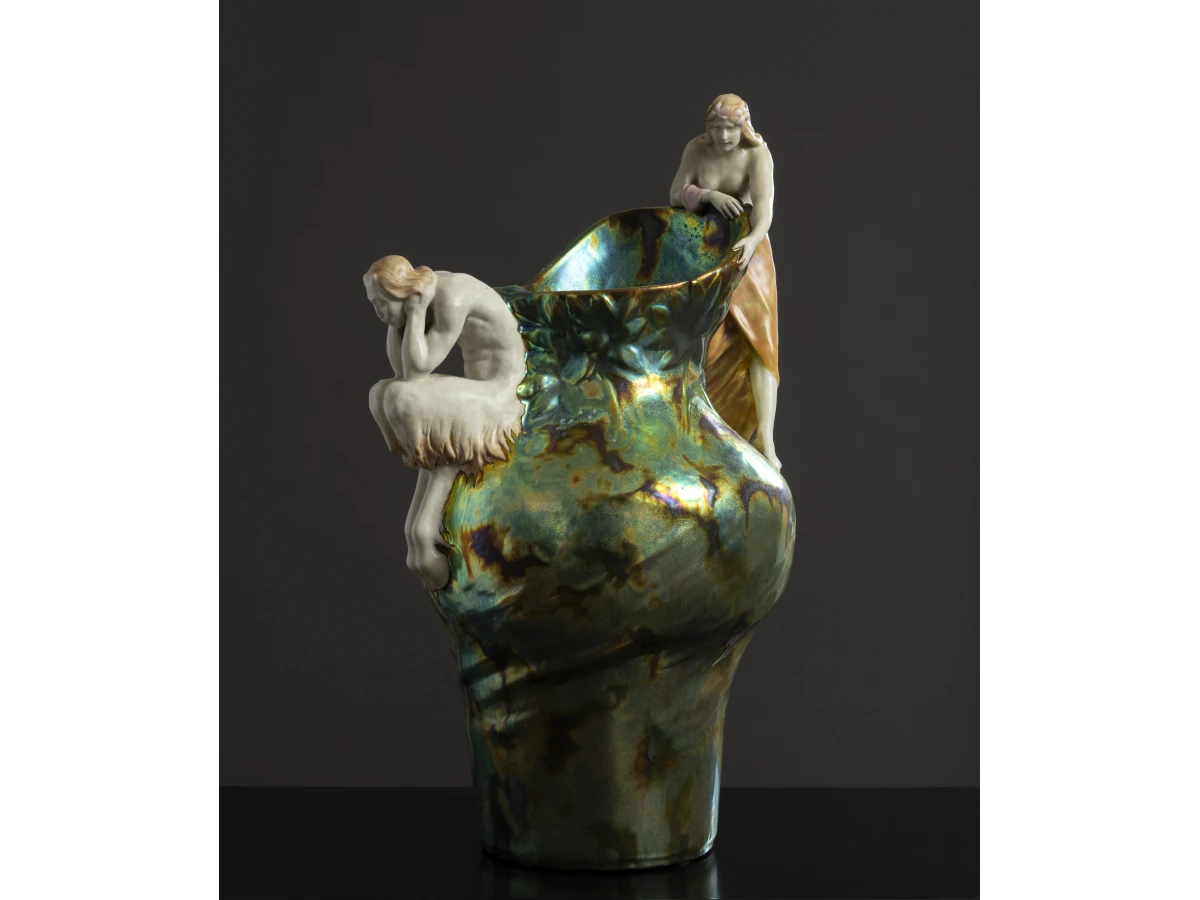
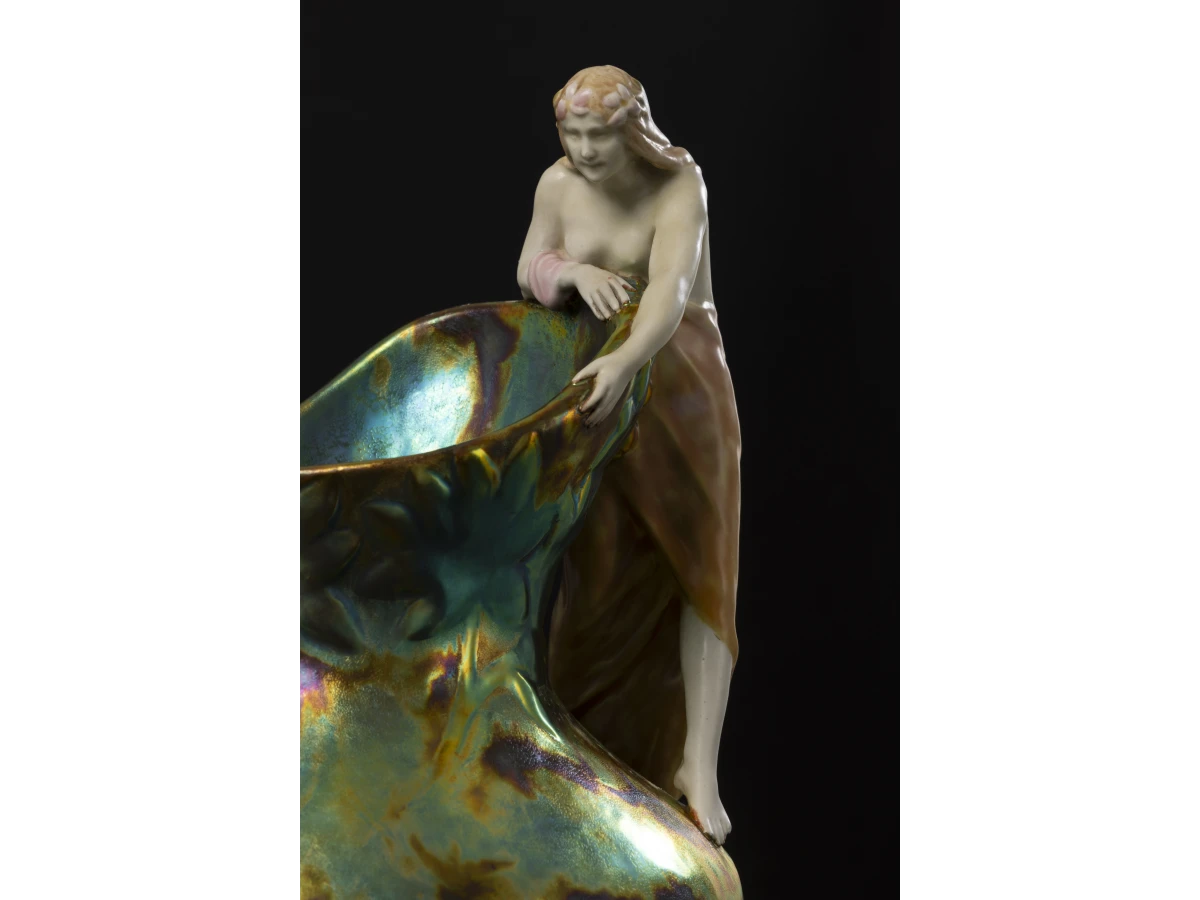
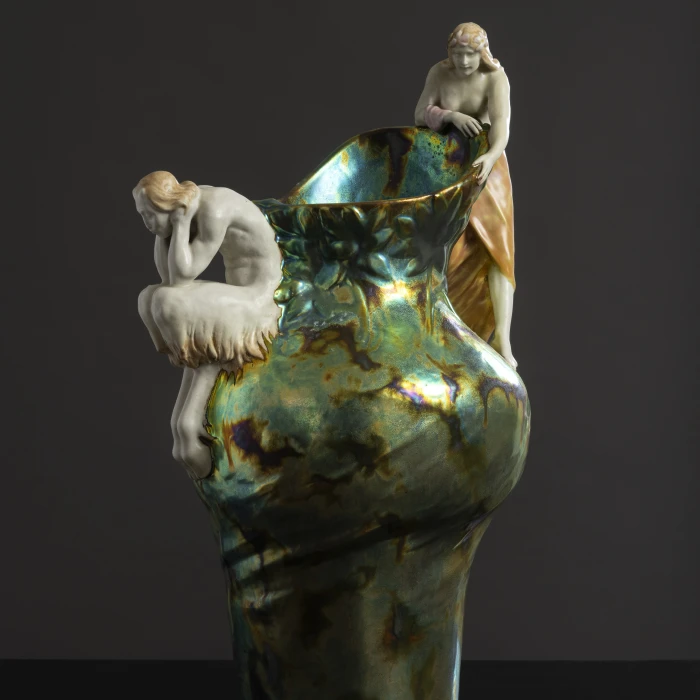
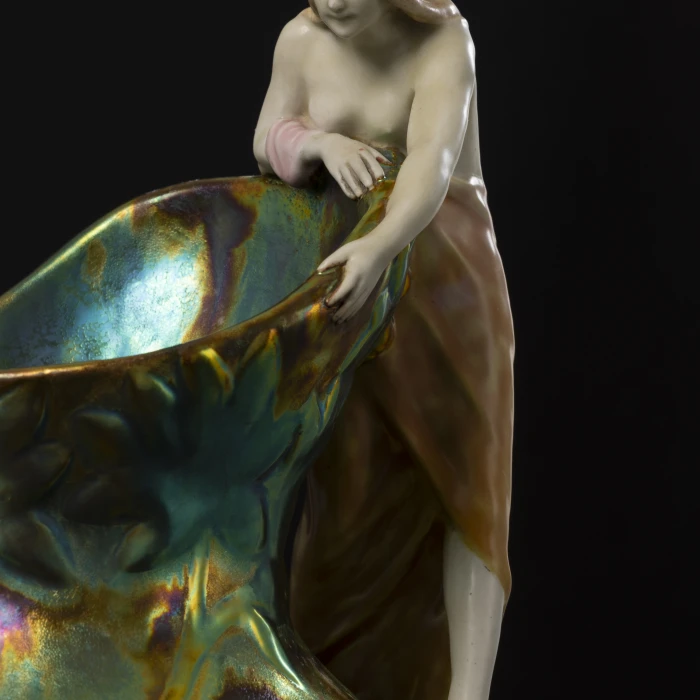
The piece exhibits a connection to classical antiquity, recognizable not only in the iconographic choice of the two sculptures, one on the shoulder and one on the neck of the vase, but also in the shape of the vase itself, which recalls ancient pre-Hellenic art, revisiting the form of an oinochoe (a jug-like vessel used to pour wine or water). On the shoulder is depicted Pan, the mythological creature from which the vase takes its name; the faun, god of the forest who wards off evil spirits, is seated in a pensive pose and is placed in place of the handle used to grasp the jug. Opposite is a standing figure: a water nymph, perhaps Syrinx, who is supported on the shoulder and neck of the vase, probably intent on fleeing, as the fearful expression on her face suggests, or hiding from the courtship of the god Pan. (In Ovid's Metamorphoses, it is said that the nymph Syrinx, a follower of Artemis, was pursued by the god Pan, intent on possessing her. She eluded him to the banks of the River Ladon, where she asked for help from the Naiads, freshwater nymphs, who responded to her cry for help by transforming her into marsh reeds, which emitted a delicate sound in the wind. Pan, having reached the banks of the river, gave up the chase, and hearing the sound emitted by the reeds, decided to build a new musical instrument, which he named after his beloved nymph: the Pan flute, also known as Syrinx.)
The vase's surface features a technique typical of the Zsolnay factory, "eosin glazing." This technique causes the colors to change depending on the angle at which the light is reflected, resulting in a unique and rich iridescence.
In this case, the color palette evokes the colors of water and the night with shades of blue, green-gold, and brown. This illusion is accentuated by the modeling of the vase's body, which imitates the flow of water, perhaps also recalling the original function of the object itself. Lajos Mack, throughout his career, created numerous models of vases, bowls, and ceramic animals for the Hungarian factory, his style being highly regarded by his contemporaries. From 1909, he began teaching modeling at the factory school, a career interrupted by his call to arms following the outbreak of World War I. Around 1930, he was rehired by the Pécs factory to reproduce some of his most successful designs.
EXHIBITIONS:
Terre d’Europa, Piacenza 1996, edited by G.C. Cammi and D. Simonazzi, Fatti d’Arte Association.
Klimt. The Man, the Artist, His World, Piacenza, GAM Piacenza, edited by G. Belli, E. Pontiggia, Skira Publishers
2022.
BIBLIOGRAPHY:
Hungarian Ceramics of Szecessziò, exhibition catalog, edited by Éva Csenkey, International Museum
of Ceramics, Faenza, 1985, Florence 1985, pp. 13-25;
Terre d’Europa, Piacenza 1996, edited by G.C. Cammi and D. Simonazzi, Fatti d’Arte Association (period photo).
Zsolnay Ceramics Collecting a Culture, edited by Federico Santi and John Gacher, Schiffer Publishing Ltd, USA
1998, p. 125, section 1897-1920.
Alfons Mucha and the Art Nouveau Atmospheres, exhibition catalog (Milan, Palazzo Reale, December 10, 2015 – March 20, 2016), edited by Stefania Cretella, Karel Srp, 24 Ore Cultura, Milan 2015, p. 148.
Klimt. The Man, the Artist, His World, Piacenza, GAM Piacenza, edited by G. Belli, E. Pontiggia, Skira Publishers
2022, p. 194, Fig. IV.5.
Artist: Lajos Mack
Year: 1900
Dimensions: 45 x 30 cm