Polycentric Service
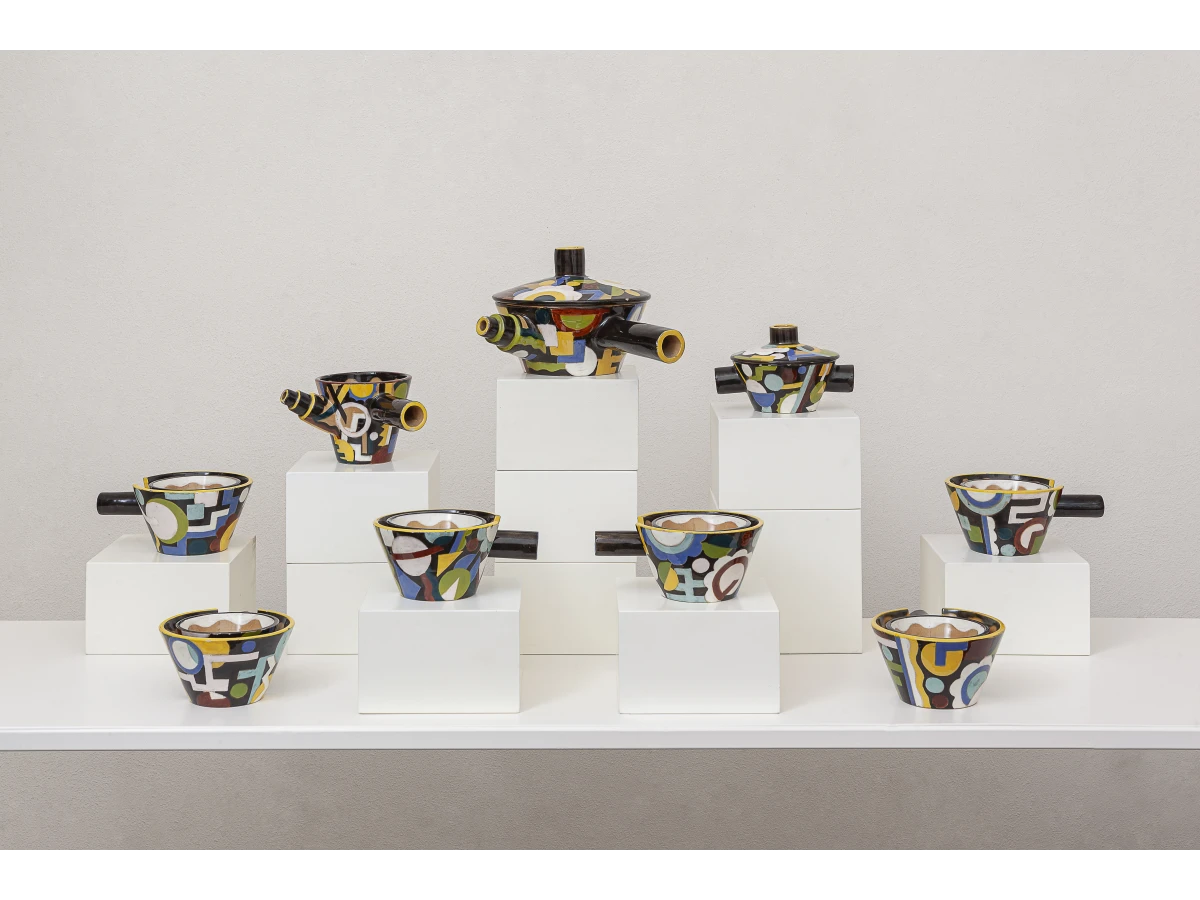
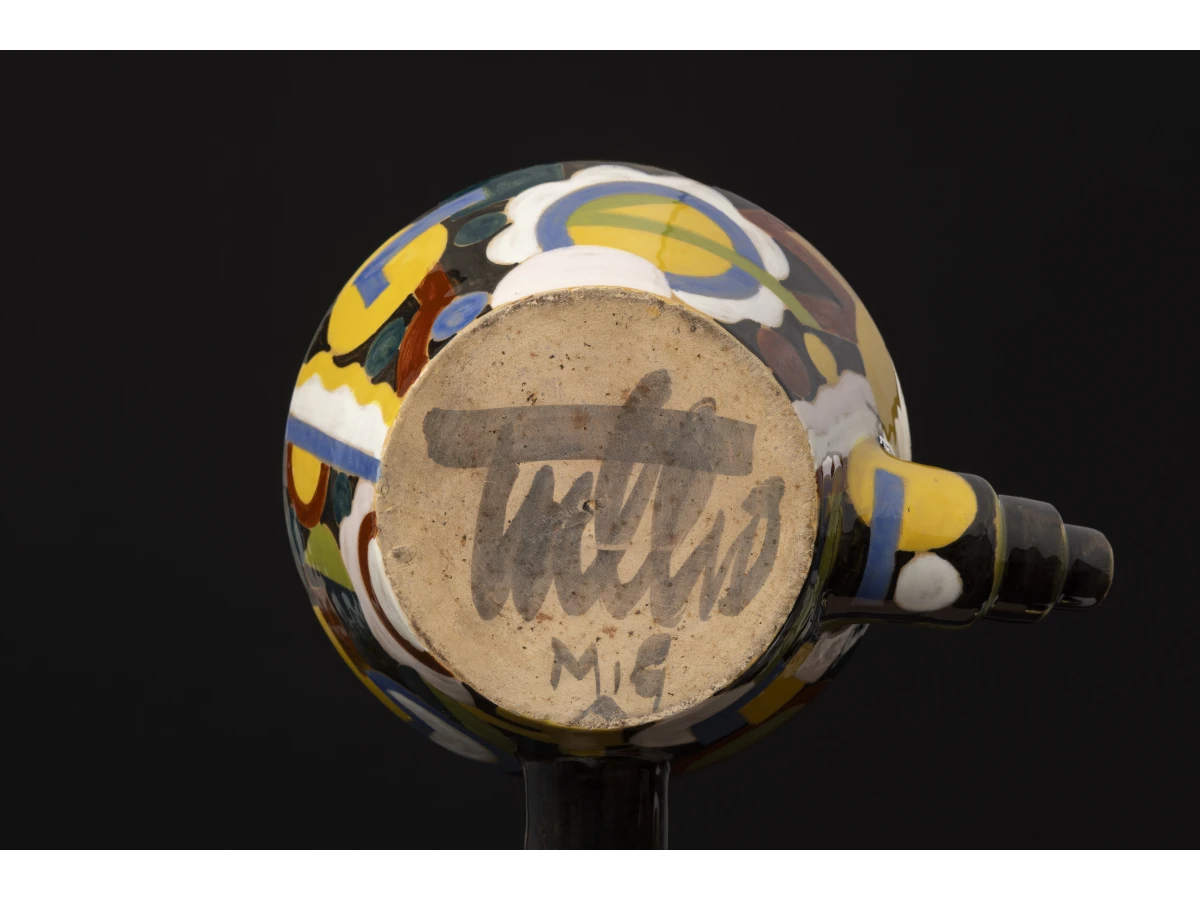
Painted terracotta glazed under varnish, made by MGA (Casa Giuseppe Mazzotti, Albisola Marina). Pieces signed "MGA" on the base; two pieces bear the autograph signature of Tullio D'Albisola, confirming his direct and personal involvement in the decoration. The service is surprisingly complete and intact in all its components.
The "Policentrico" tea service represents a significant and fundamental testimony to the adherence of the
Ligurian ceramist Tullio D'Albisola to the expressive demands of the Futurist movement. Characterized by an abstract decoration
and characterized by an unprecedented formal typology, the set marks a crucial phase in his linguistic
evolution under the aegis of the avant-garde founded by Filippo Tommaso Marinetti.
The artist's first encounter with Futurism occurred in 1925 at the Exposition Internationale des
Arts Décoratifs et Industriels Modernes in Paris, where Tullio and his brother Torido were exposed to the works
of Enrico Prampolini, Fortunato Depero, and Giacomo Balla. From that moment, Tullio felt the need to innovate
in an "anti-imitative" direction in his research, abruptly breaking away from traditional craft to free
terracotta work from a sterile reproduction of centuries-old decorative motifs. In August 1925, he created
his first Futurist ceramics, later described by Marinetti as aiming to "forget, surpass, and overturn
the ideas and techniques of every ceramic secret with the Nuovissimo, the Originalissimo, and the Maivisto."
His definitive recognition came in 1929 at the exhibition of thirty-three Futurist artists at the Galleria Pesaro in Milan, where Tullio displayed a wide range of his work. In these works—called
"arcivasi," "bibocali," "tuberie," and Futurist services—the emerging avant-garde movement initially manifested itself
by applying geometric decorations to Art Deco-inspired models, rapidly evolving towards a progressive
plastic transformation and a coherent interpenetration of decoration and form.
Inspired by a functionalist predisposition, the abstract decorations of this service masterfully integrate geometric
motifs and structural dynamics, testifying to the expressive maturity achieved between the 1920s and
1930s, a period in which Albisola established itself, as Marinetti himself defined it, as the true "ceramic capital of Italy."
BIBLIOGRAPHY & COMPARATIVE EXHIBITIONS
Enrico Crispolti (ed.), Futurist Ceramics from Balla to Tullio D’Albisola, Edizioni Centro Di, Florence,
1985, p. 104 (similar piece exhibited at the exhibition of the International Museum of Ceramics in Faenza and the
Municipality of Albisola Superiore).
Cecilia Chilosi, Liliana Ughetto (ed.), 20th-Century Ceramics in Liguria, Istituto Grafico Silvio Basile,
Genoa, 1995, p. 119, f. 138 (see for a similar work with a variant decoration).
A similar and contemporary piece is held in the permanent collections of the MIC - International Museum of
Ceramics in Faenza, a point of reference for the sculptural articulation of the "Policentrica" series.
Artist: Tullio d'Albisola
Year: 1929
Dimensions: Varie