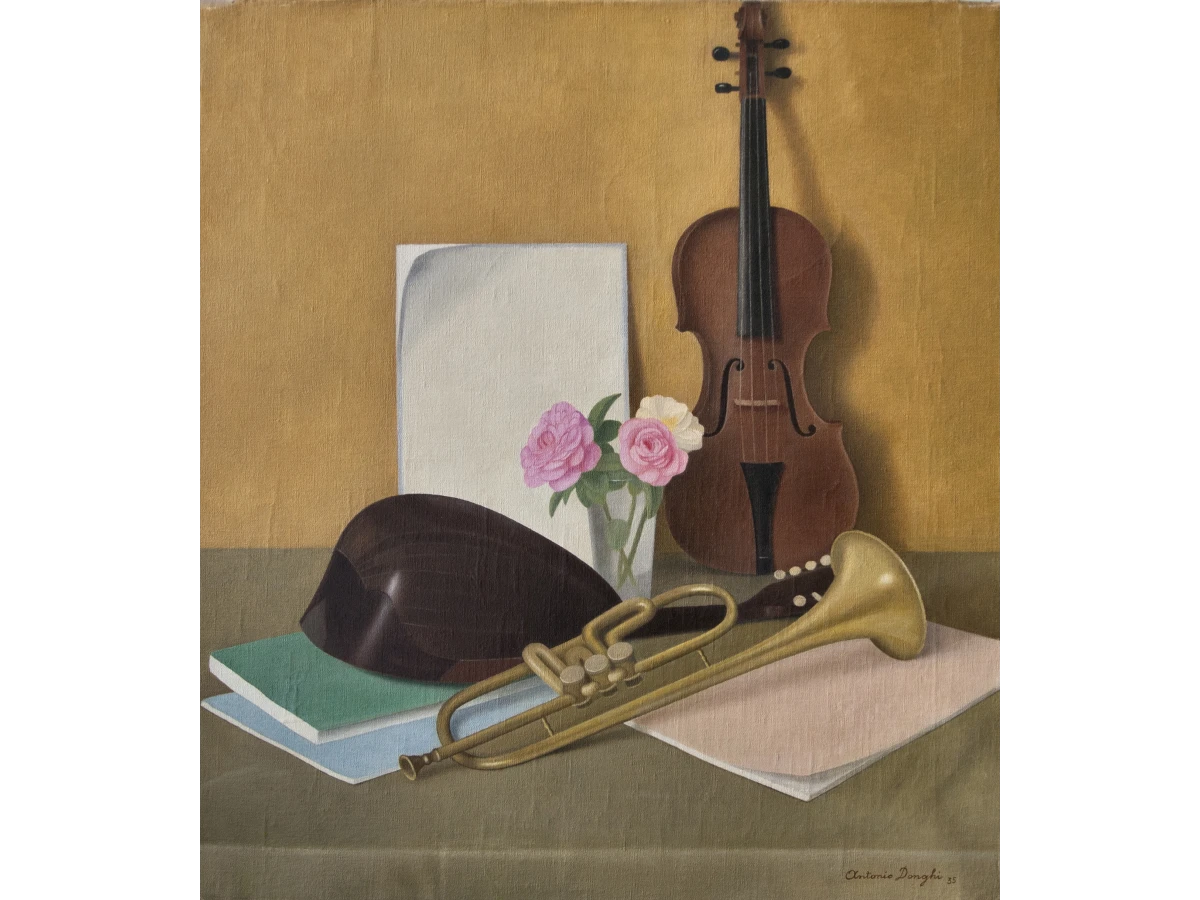
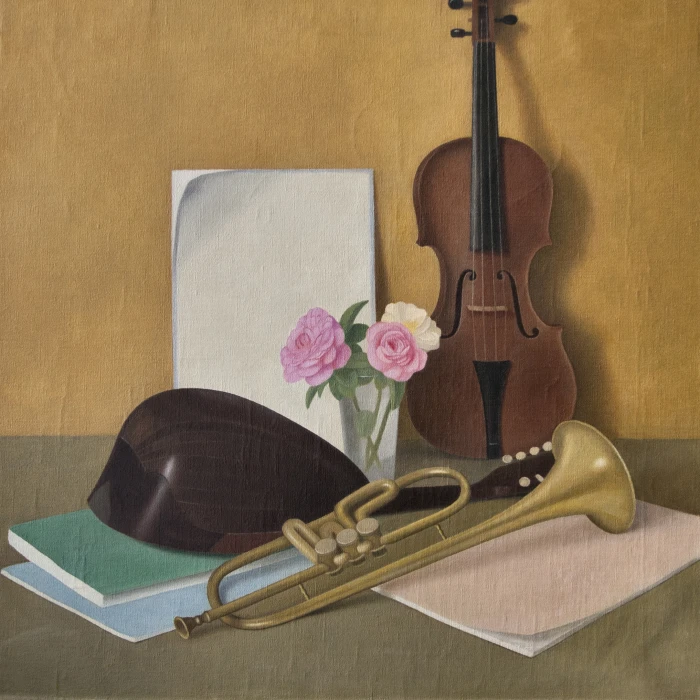
Still Life with Musical Instruments
Inscriptions: Bottom right “Antonio Donghi 35”
Since the mid-1920s, Donghi participated in numerous international exhibitions, not only in Europe but also in the United States. In 1926, he presented ten works at the Exhibition of Modern Italian Art, organized by the Ministry of Public Education and hosted in various American cities, while the following year he held a solo exhibition in New York. Toward the end of the 1920s, he frequently exhibited abroad with the Novecento Italiano group, attending the significant international showcase in Buenos Aires in 1931.
A major milestone for his establishment among American collectors was his participation in the 26th edition of the Carnegie Prize in Pittsburgh in the autumn of 1927. During these years, the exhibition was curated by Homer Saint-Gaudens, while the Venetian Ilario Neri acted as the promoter of Italian art in Pittsburgh. The jury, which included Felice Casorati and Maurice Denis, awarded Donghi the First Honorable Mention for the work Carnevale (Carnival), which shortly thereafter entered an American collection along with other works.
Throughout the 1930s, there were numerous acquisitions of Donghi's works by Italian museums as well, and in 1935, the artist presented an important selection of paintings at the Rome Quadriennale. He received many accolades, culminating in the first monographic publication dedicated to him, which was released in 1942 in the Arte Moderna Italiana series edited by Giovanni Scheiwiller (Sinisgalli 1942). His relationship with the American art world continued after World War II, as evidenced by his invitation, in 1949, to the celebrated exhibition Twentieth-Century Italian Art, curated by James Thrall Soby and Alfred H. Barr for the MoMA in New York.
In Donghi's oeuvre, alongside figures in indoor and outdoor settings and more complex compositions, there are numerous still lifes—mainly of flowers or fruit. These were always rendered with an extreme simplification of forms and volumes, featuring vibrant contrasting colors and cut by an unreal light aimed at creating a suspended atmosphere, a new time and a new space, as Massimo Bontempelli wrote in the first issue of the magazine “900”: “The most urgent task of the twentieth century will be the reconstruction of time and space” (Bontempelli 1926). Compared to his still lifes with flowers or fruit, this specific painting features a rarer subject within Donghi's production and a more complex arrangement of elements. This genre was deeply rooted in the Italian tradition, starting from the seventeenth-century production of Evaristo Baschenis from Bergamo, which was revived by numerous artists during the 1920s. Within the atmosphere of the Italian ‘Return to Order,’ references to music were frequent, as seen in the still lifes with musical instruments created by Piero Marussig and Achille Funi. In relation to the German art scene, Natura morta con strumenti musicali (Still Life with Musical Instruments) comes close to the works of Alexander Kanoldt, one of the leading figures of the classical and Munich-based wing of Magic Realism.
In Leonardo Sinisgalli's monograph (Sinisgalli 1942), the artwork was attributed to the collection of Baroness Anita Blanc, while its identification as the piece exhibited at the 1936 Venice Biennale is confirmed by a photograph preserved in the archives of the Venetian institution. In other still lifes with similar subjects, Donghi reworked the same elements—including the musical score, the violin, and a vase of flowers—always maintaining a high concentration on the synthetic rendering of the elements and the estranging quality of the composition. One of these, dated 1940, was auctioned at Sotheby’s in 2011 and came from the famous collection of New York gallery owner Alexander Jolas, further confirming how Donghi can be considered a trait d’union not only with Northern European realism but also with the American world.
Bibliography: XX Esposizione 1936, no. 26; Sinisgalli 1942, pl. XXV; Antonio Donghi 1983, Rome, Galleria dell’Oca, no. 16 (dated 1936); Antonio Donghi 1985, p. 136; Fagiolo dell’Arco, Rivosecchi 1990 p. 205, no. 103.
Artist: Antonio Donghi
Year: 1935
Dimensions: 64 x 56 cm