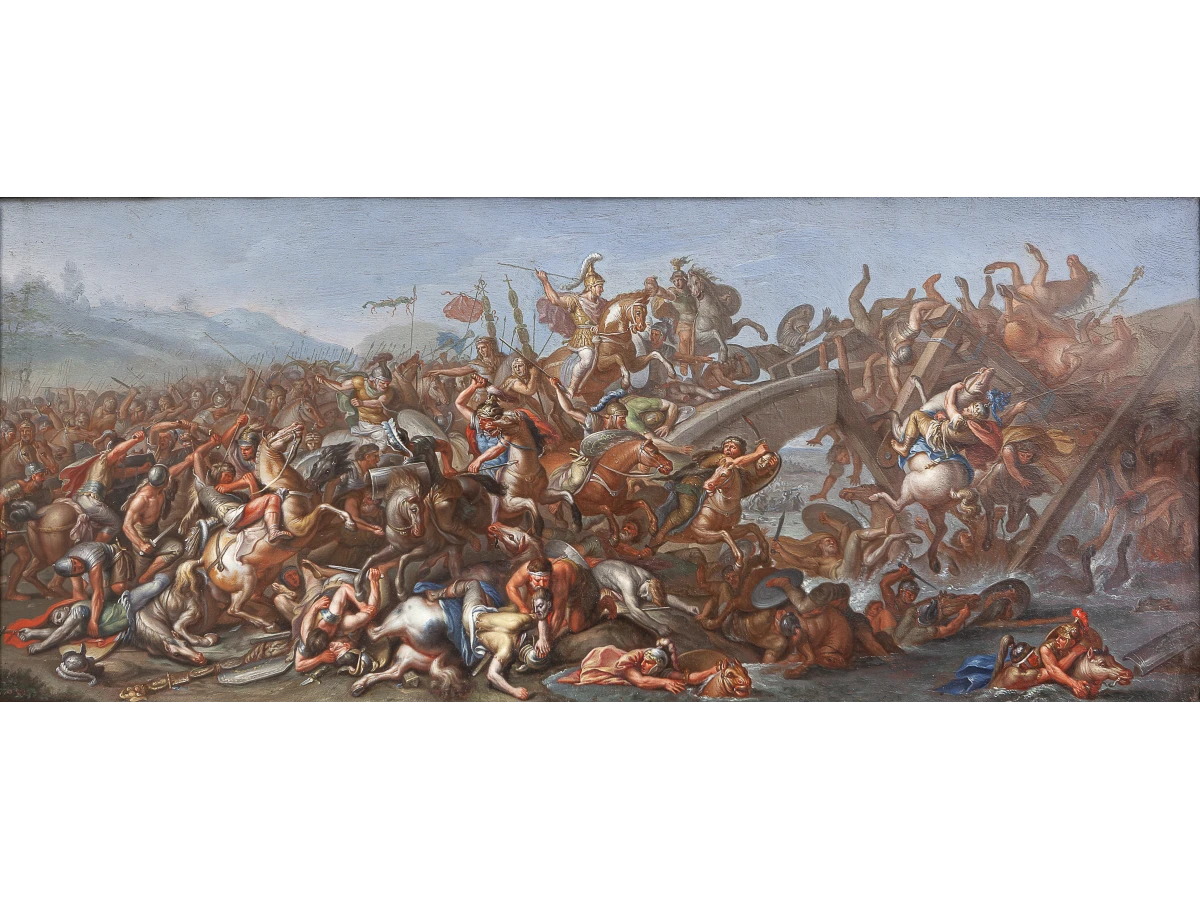
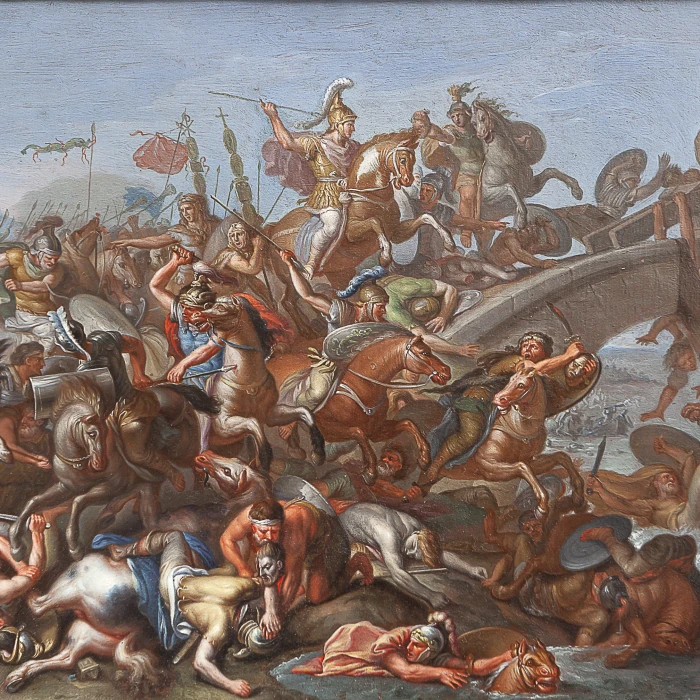
Battle of Milvian Bridge
French painter (Paris 1619-1690). A dominant figure in the artistic environment of the time, he contributed with his work to the determination of the magniloquent and sumptuous physiognomy of the French Baroque, in which he was able to express the political and social ideals of the absolute monarchy of Louis XIV, creating a paradigm valid for all the European courts. A pupil in Paris of F. Perrier, then of S. Vouet, he completed his training in Rome where he went, from 1642 to 1646, with Poussin, whose lesson played a large part in the formation of his style (Horace Cocles, London, Dulwich College Gallery). Returning to Paris (1647) he executed some sacred altarpieces (Martyrdom of Saint Andrew and Martyrdom of Saint Stephen at Notre-Dame); then important decorative complexes for the hotels Lambert and de la Rivière (1652-53), and finally for the castle of Vaux-le-Vicômte, where the organization of the decorative apparatus reveals the versatility of his interests. In 1660 he painted the family of Darius in front of Alexander for Louis XIV and the following year he entered the king's service, thus beginning a brilliant career. As director of the Gobelins (1663) he prepared numerous cartoons (the Seasons, the Battles of Alexander, the Months) and designs for furniture and silverware; as the king's first painter and "prince" of the Academy of Painting, he had a great influence and teaching activities supporting classical principles. In perfect harmony with the intentions of the monarch and of Colbert, he attended the monumental realizations of the Louvre (decoration of the Gallery of Apollo) and of Versailles (Gallery of Mirrors, 1678-84; Salons of Peace and War), of Saint-Germain, Sceaux, Marly; in the painted parts of his hand, allegory and history find a formal and measured form and at the same time of extreme and baroque "evidence". The arrival of Louvois to the superintendence of the Bâtiments (1683) marked the progressive exclusion of Le Brun from the great commissions and his approach to easel painting (Moses defending the daughters of Jethro, 1686, and Moses takes Zipporah as his wife, 1687, Modena, Galleria Estense; cycle of the Life of Christ, 1688-89, Paris, Louvre), which he treated with diligence but with little inspiration
Artist: Charles Le Brun
Year: 1660/1670