Love and Psyche
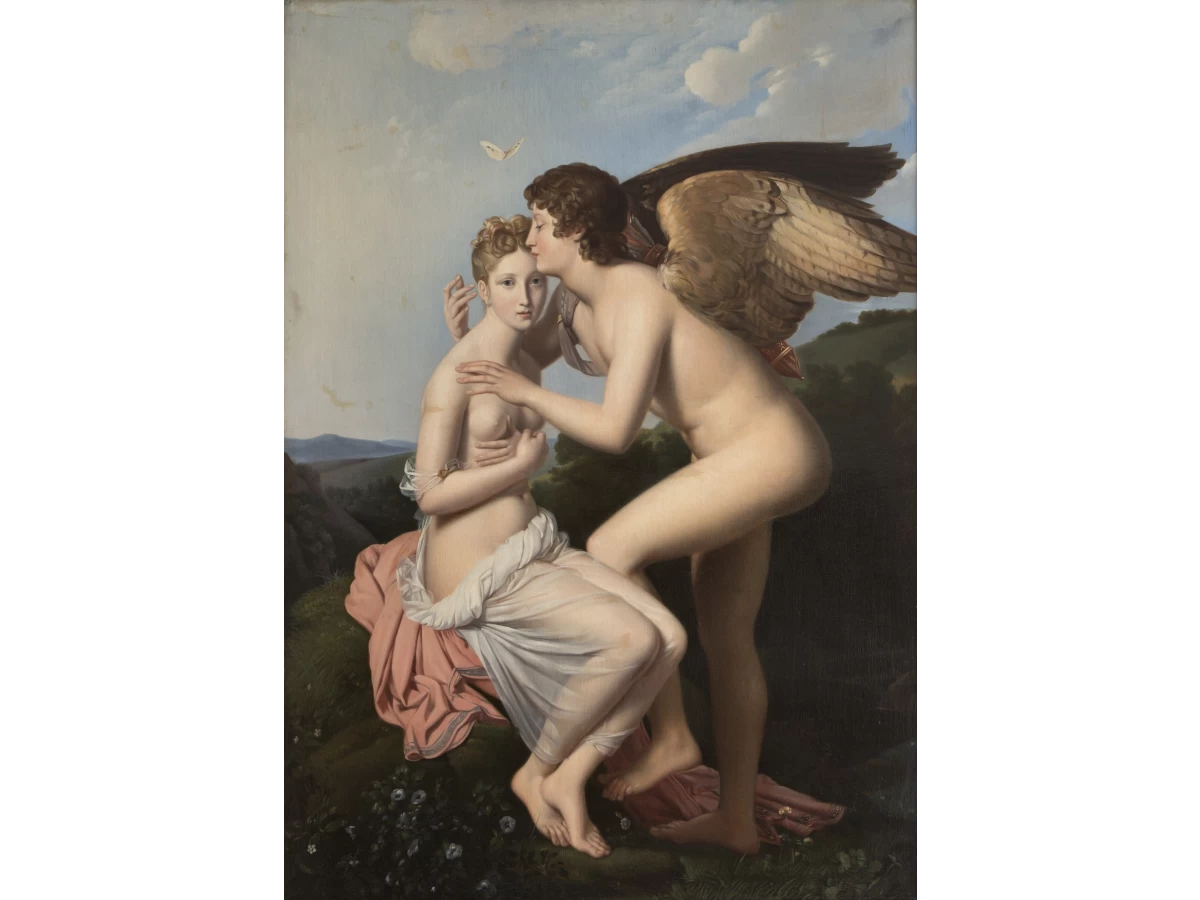
The slightly smaller painting, housed at the Musée du Louvre (1798, 186 x 132 cm, inv. 4739), although not cited in sources, stands out for the high quality of its pictorial technique, attributable to Gérard himself.
The prototype was exhibited at the Salon of 1798, meeting with mixed reviews. This prevented the young artist, then one of David's best students, from immediately establishing himself on the Parisian scene, delaying his consecration until a few years later, but in the less "courtly" genre of portraiture. Those who appreciated the work in particular were some of David's former students, who had distanced themselves from him, calling themselves "primitives" and seeking archaic forms. Gérard's first biographer, Charles Lenormant, emphasized the young painter's closeness to this new movement: "While he did not share the follies of those who called themselves 'primitives,' he seemed to disdain the resources of modern art; he seemed to want to systematically limit himself to the four colors of early Greek painting. And he would probably have remained faithful to this single idea, had the need to paint portraits not led him back—before any of his other emulators—to realism" (S. Laveissière, Psyche and Love by François Gérard. "A simple and sweet painting," in Love and Psyche in Milan, exhibition catalog (Milan, Palazzo Marino, December 1, 2012-January 13, 2013) edited by V. Pomarède, V. Merlini, and D. Storti, Soveria Mannelli 2012, pp. 85-97).
Even Ingres, who was close to this group without belonging to it, praised his colleague's work; while among the critics, Julien de Parme, Gérard's former teacher, criticized
the excessive geometricization of the poses and the multiplicity of angles that emphasized the scene's aura of unreality.
With this subject, Gérard responded to the need for grace and subtle eroticism that was emerging in the mid-1890s, after nearly a decade characterized by "committed" scenes (P. Lang, Regards sur Amour et Psyché à l’âge néoclassicique, exhibition catalog (Zurich, Musée Carouge, Swiss Institute for the Study of Art, 1994), Zurich 1994, pp. 101-105). Along these lines, Girodet had already presented his Endymion (Paris, Musée du Louvre) at the Salon of 1793, and Prud'hon's Union of Love and Friendship (Minneapolis/Minnesota, The Minneapolis Institute of Arts), the latter destined to influence ours from a compositional point of view, while at the 1798 exhibition Jean-Jacques Lagrenée the Younger also presented Psyche in the Enchanted Palace Where She Was Transported by Love (private collection).
Two years before Cupid and Psyche, at the Salon of 1796, Gérard had exhibited several works featuring the same protagonists: four drawings illustrating La Fontaine's Les Amours de Psyché et de Cupidon, published by Pierre Didot in 1797. According to the myth recounted by Apuleius in his Metamorphoses (or The Golden Ass), Venus decided to punish Psyche for her beauty by asking her son to make her fall in love with a monstrous being. Upon seeing her, Cupid decided not to grant his mother's request: he kidnapped Psyche and took her to his palace, where he joined them at night, remaining invisible. Urged on by her sisters, Psyche yearned to see her lover in his sleep; awakened by a drop of oil falling from the lamp, she was chased away. To regain his trust, Venus subjected her to four tests, which she managed to overcome thanks to the help of providential collaborators. The last, however, led her into an eternal sleep, from which she was awakened by Cupid's kiss (a moment depicted by Canova in the version now at the Musée du Louvre).
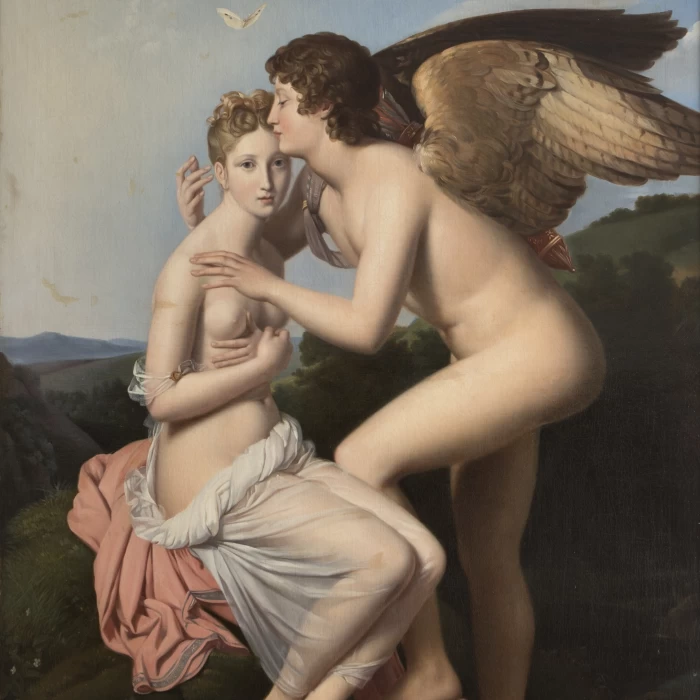
In 1796, the young painter set to work, refraining from depicting a specific moment in the tale, preferring instead to depict an unseen scene that precedes the four trials: Cupid's first kiss, invisible, to Psyche who, experiencing an unfamiliar sensation, modestly folds her arms over her chest. From an allegorical perspective, the image could thus refer to the first emotion provoked by newly blossomed love, since Psyche is the personification of the soul (to which the butterfly fluttering above her head also refers).
It took two years, not without difficulty, to complete the final work from the sketch (21.7 x 15 cm; location unknown: see ibid., p. 89). The features of the female figure were perhaps inspired by Emile Brongniart for the face (the aforementioned sketch of the painting belonged to her) and Céline Cochelet for the body, both famous Parisian beauties of the time, while the handsome painter Jacques-Luc Barbier was the probable model for Love (Laveissière 2012, p. 92).
Artist: Francois Pascal Simon Gérard
Year: 1798 ca.